
Finding Palm Springs Residents
A useful Palm Springs residents directory is a chain of official indexes, not one master roster. Begin with the Palm Beach County Property Appraiser Public Access portal, known as PAPA, when an address or owner name is known. It shows the parcel control number, or PCN, legal description, current owner, situs address, mailing address, homestead result, building facts, and last deed book and page. The situs is the physical parcel address. The mailing address is where the tax notice goes. A match between them and a homestead flag supports owner occupancy, but it does not name every person in the home.
For a name search, compare property results with an official record that serves a different purpose. The Clerk's deed index connects parties to recorded instruments. A voter-file request may confirm a registered address, subject to protected-address exemptions. eCaseView can connect a party to a county court or probate file. Each roll leaves people out. Renters, children, unregistered adults, and people whose addresses are protected may not appear in an address-keyed result at all.
- Search PAPA by owner, full address, or PCN. Save the municipality, legal description, mailing address, and last book and page.
- Search Landmark Official Records for the name and deed reference. Try spelling variants and broad dates.
- Use the state voter status tool only for an authorized self-check. Ask the Supervisor of Elections for an existing public voter-file extract when broader research is lawful.
- Check county court, probate, business, license, newspaper, or vital sources based on the fact that needs confirmation.
- When the index is not online, contact the custodian or make a focused Chapter 119 request for an existing record.
Keep names separate until two anchors agree. A middle initial, spouse, PCN, legal description, known address, license, or case relationship can distinguish people who share a surname. Palm Springs has a large Hispanic and Latino community, so searches should preserve compound surnames, both family names, accents, spacing, and alternate ordering.
Palm Springs Records Offices
Palm Springs is legally a village within Palm Beach County. Durable resident records therefore sit mainly with county constitutional offices. The Clerk records deeds, mortgages, liens, judgments, plats, marriage licenses, and court or probate files. The Property Appraiser publishes the assessment roll and parcel map. The Supervisor of Elections holds the voter file. Village staff keep permits, code cases, police reports, council records, and local licenses. Use the Palm Springs city directory for older collections and the Palm Springs street directory for the full address workflow.
Palm Beach County Recording
205 North Dixie Highway
West Palm Beach, FL 33401
561-355-2932
Palm Beach County Property Appraiser
301 North Olive Avenue
West Palm Beach, FL 33401
561-355-2866
Palm Beach County Elections
4301 Cherry Road
West Palm Beach, FL 33409
561-656-6200
Palm Springs Property Roll
PAPA is the strongest first stop for a Palm Springs address because it accepts a simple owner name, street address, or PCN. Its advanced form adds street number, direction, name, suffix, unit, ZIP, municipality, subdivision, condominium, book and page, legal description, property type, value, and section-township-range. Results can be printed or exported. That makes the roll useful for isolating Palm Springs parcels and comparing nearby properties without claiming that each listed owner lives there.
The PAPA search entrance shows how the county presents parcel and owner access.
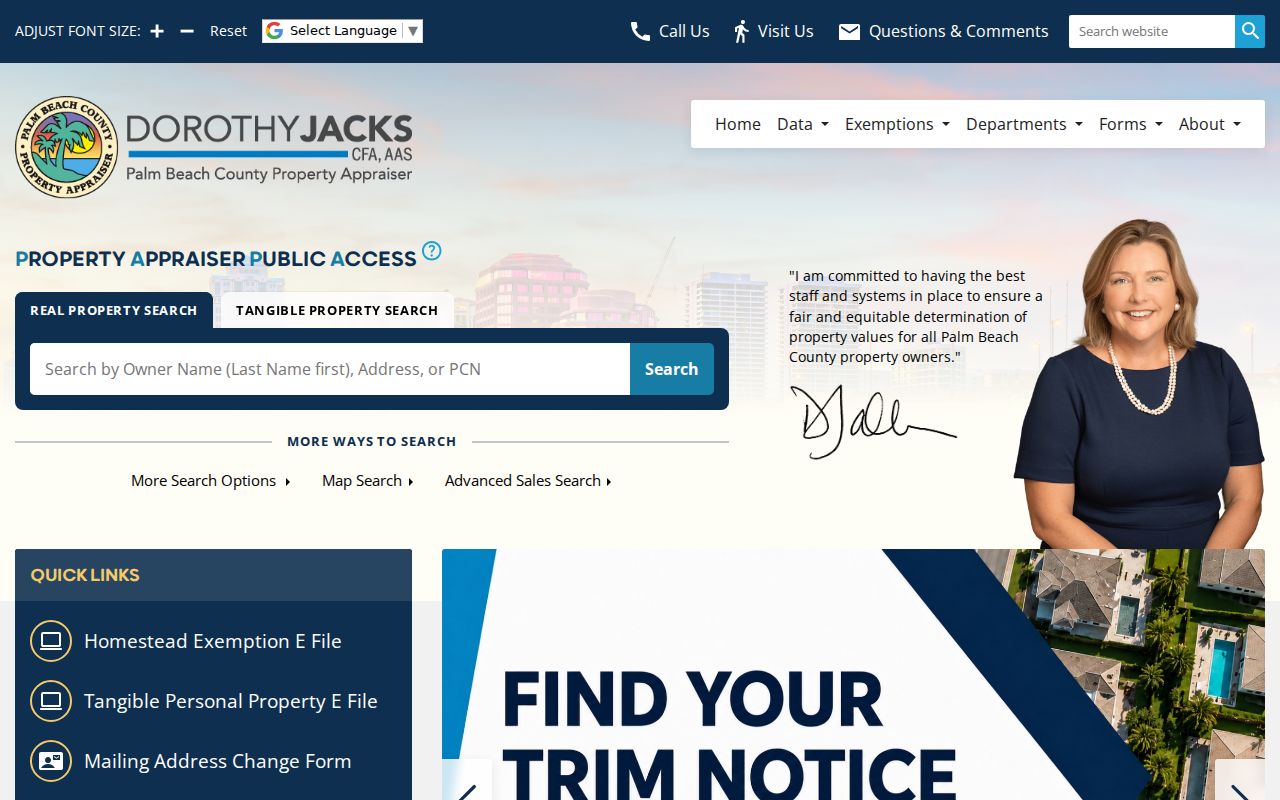
The portal links the name result to the parcel map and the recorded deed reference, which is the key handoff from a current roll to an ownership history.
- Parcel
- A mapped piece of real property with its own PCN.
- Situs address
- The assigned location of the parcel, not the owner's mailing destination.
- Homestead
- A visible exemption result that may support owner occupancy; the application itself is confidential.
- Book and page
- The Clerk's reference for locating a recorded instrument.
Palm Springs Deed Records
Landmark Official Records searches grantors and grantees, the parties who transfer property, along with document type, recording dates, book and page, legal description, parcel ID, and several land-description fields. Online document images begin January 1, 1968. Marriage listings reach 1909, and plats or right-of-way maps may reach the late 1800s. Earlier Palm Springs deed work can continue at the Main Courthouse through microfilm, older books, an abstract search, mail research, or a Records Service Center request.
The Landmark search screen is the county's official starting point for recorded instruments.
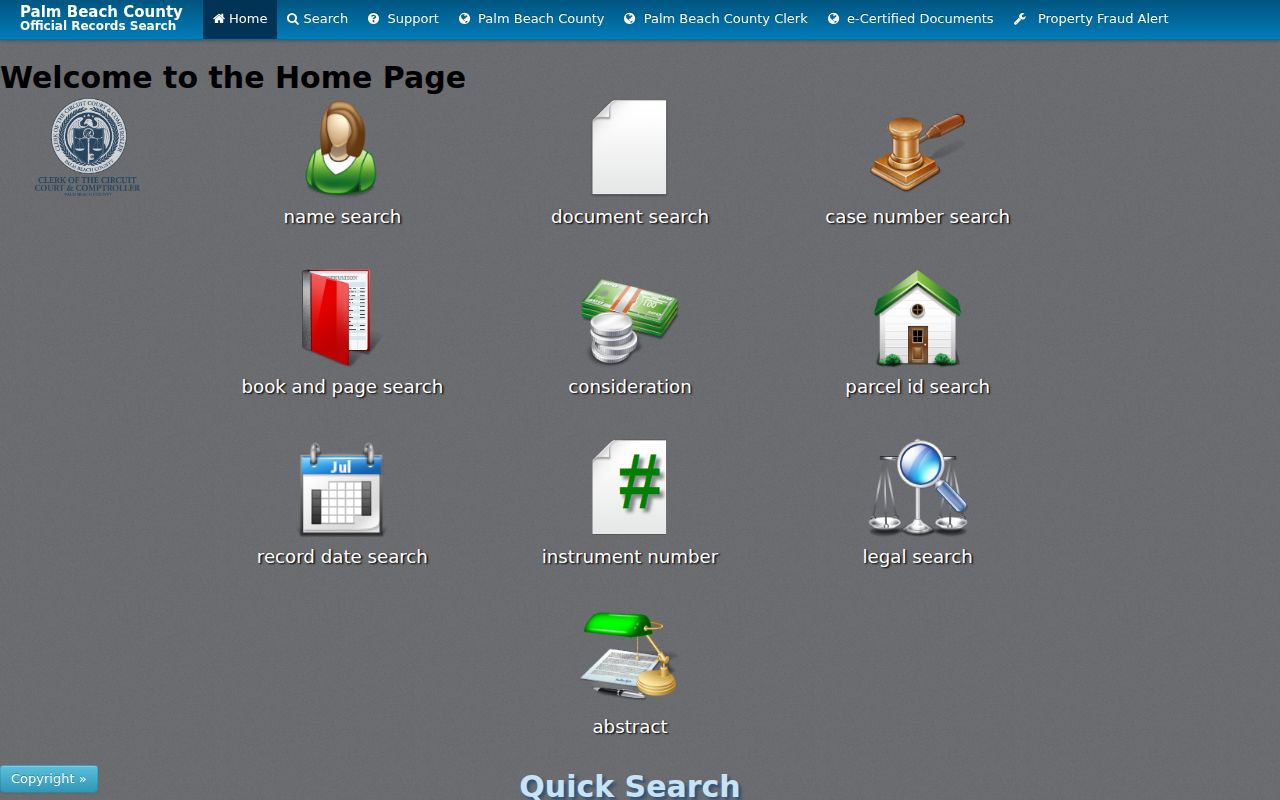
Accepting the portal notice opens search modes built for names, book and page references, parcel IDs, and land descriptions. Uncertified images can be printed without charge where display is allowed. Certified copies and restricted images require the Clerk's copy or counter process.
Palm Springs Court Lookups
County and circuit cases belong in eCaseView, while Florida appellate cases use the separate ACIS portal. A party-name result can provide a case number, role, filing date, case type, status, judge, events, and available docket documents. It can confirm that a person participated in a public case. It cannot prove that every address or same-name result belongs to the Palm Springs resident being researched. Sealed, expunged, juvenile, adoption, and other confidential material will not appear.
The eCaseView entry supports free guest searches and broader criteria for registered users.
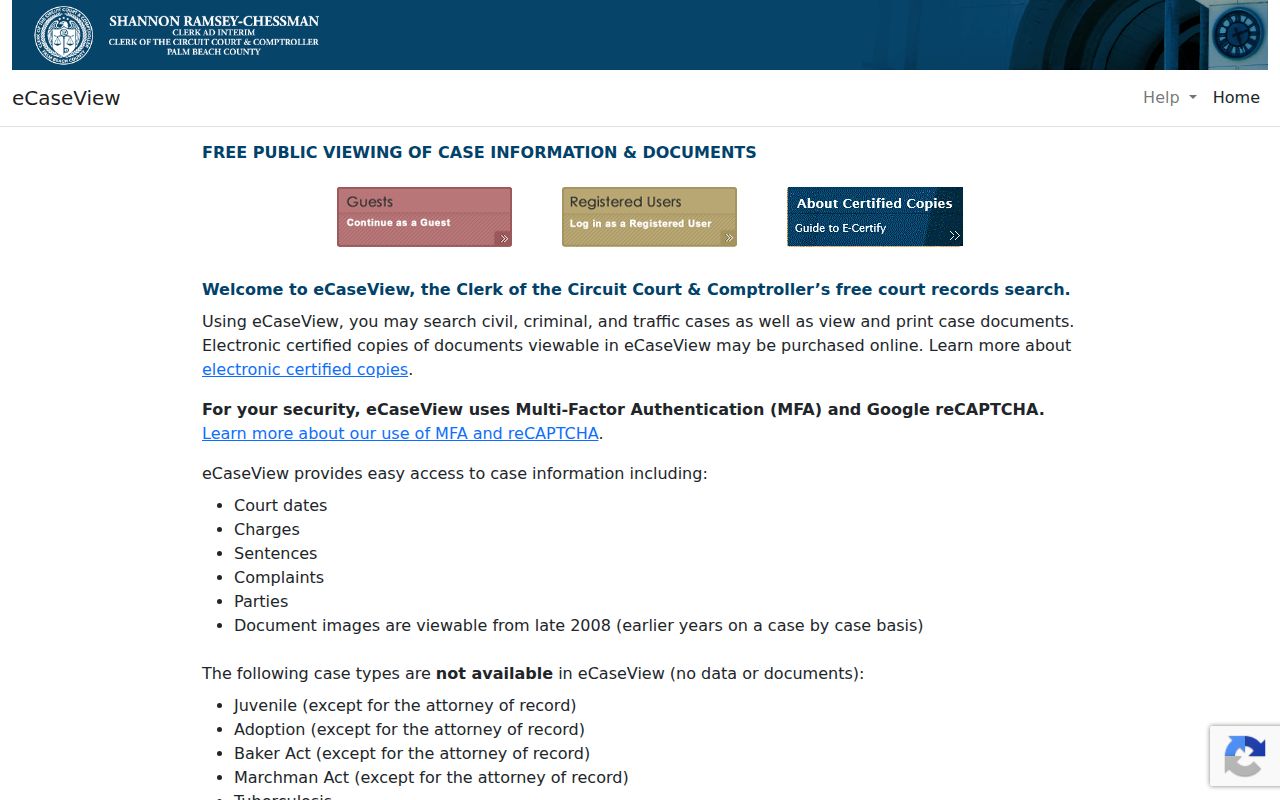
Use case relationships and dates as verification anchors. Probate files are especially useful for lawful family-history or heir research because public petitions and orders may identify a personal representative or heirs, subject to redaction.
Current Palm Springs Directories
No current source lists all Palm Springs residents. Each official directory-like roll answers a narrower question. Property records show owners, the voter file shows registered voters who are not protected, deeds show parties to instruments, and business or professional registries show public filing relationships. Treat the source's stated role as its limit.
| Source | Who It Lists | Keeper | Access |
|---|---|---|---|
| PAPA assessment roll | Parcel owners | Property Appraiser | Free portal and export |
| Public voter file | Nonexempt registered voters | Supervisor of Elections | Request by portal, mail, phone, email, or fax |
| Landmark index | Parties to recorded instruments | Clerk Recording | Free index and many images |
| Sunbiz and DBPR | Business principals and licensees | Florida agencies | Free statewide searches |
| Village public files | Named parties in permits, code, and council records | Village custodian | Online request tracker or direct request |
Choose by the fact to prove. Ownership belongs to PAPA and the deed. A current registered address belongs to the elections custodian, not the self-service status screen. A company role belongs to Sunbiz; a regulated license belongs to DBPR. The Palm Springs resident lookup shows how to compare two sources without merging names.
Palm Springs Voter Records
Florida's Voter Information Lookup is a personal status check. It asks for first name, last name, and date of birth, and it is not a public surname browser. The fuller resident-record channel is Palm Beach County Supervisor of Elections. County guidance says most voter names, addresses, dates of birth, party affiliations, phone numbers, email addresses, and participation history are public, subject to statutory exemptions. Participation history shows whether someone voted, never the ballot choice.
The Florida voter status form makes the identity-field requirement clear.
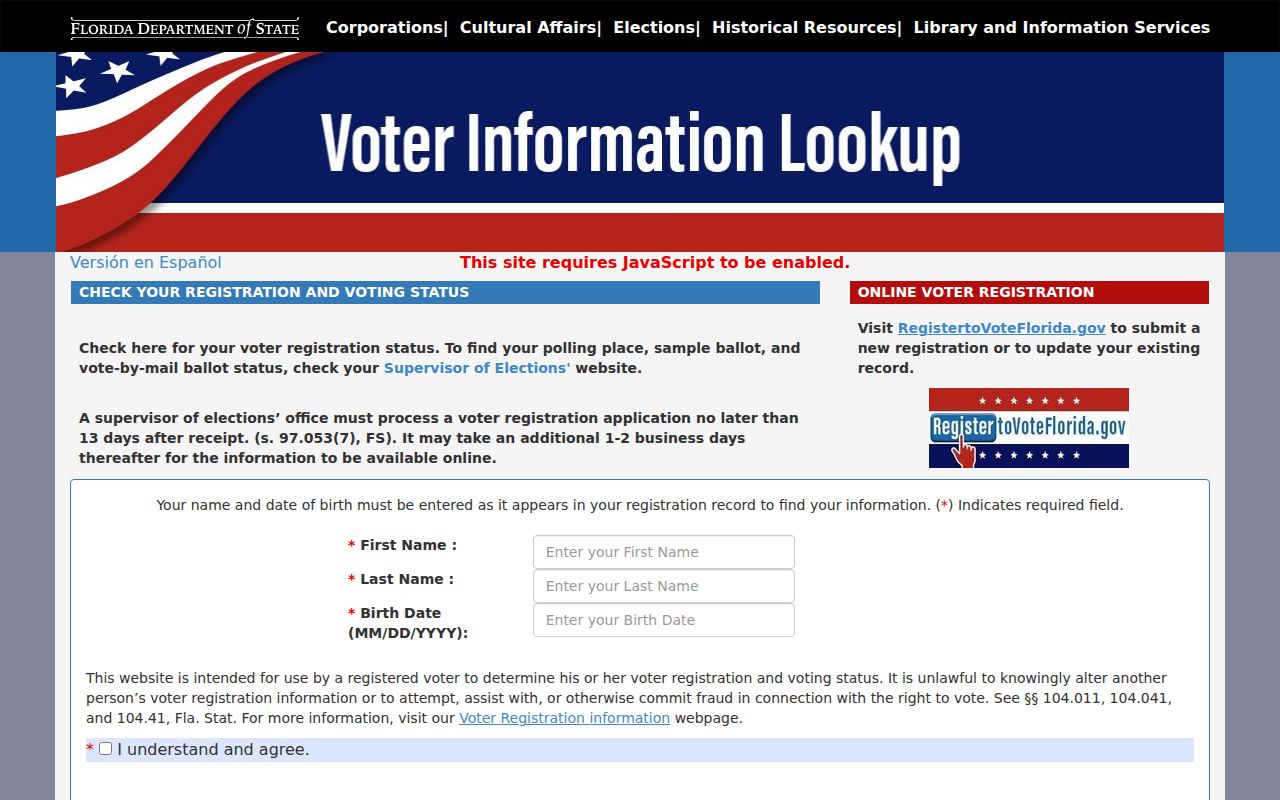
For public-file research, use the county request portal or contact the office by mail, phone, email, or fax. Ask for an existing geographic extract rather than a custom answer. The file still omits nonregistered adults, minors, inactive or moved registrations, and protected voters.
Florida's Address Confidentiality Program and exemptions in Chapter 119 can suppress an actual home address. An absent or substitute address is a privacy control, not evidence that the person does not live in Palm Springs.
Palm Springs Public Records Requests
Florida's Public Records Law rests on article I, section 24 of the state constitution and Chapter 119 of the Florida Statutes. A requester generally does not need to state a purpose or use a special form. The custodian must provide prompt access to nonexempt existing records, redact protected portions, and identify the basis for withholding. An office does not have to create a new record or research a conclusion.
The official section 119.07 text covers inspection, copies, redaction, response, and fees. Start with the agency that created the record: the village for current village permits or code files, the county Property Appraiser for parcel fields, the Clerk for recorded instruments and court files, or Elections for voter data. Include the name or address, spelling variants, a date range, record type, and preferred format.
Ordinary copies may carry statutory duplication charges. Extensive use of information technology or clerical or supervisory help may result in a special-service charge quoted in advance. Ask to inspect first when practical, or narrow the request to an existing index. A focused request is usually faster.
Verifying Palm Springs Residents
One record rarely resolves identity. A PAPA owner result may use a mailing address outside Palm Springs. A Sunbiz address may be an agent or business office. A license address may be a work site. A court filing may be old, and a voter record may be protected or inactive. Match at least two independent anchors before linking records to the same person.
| Question | First source | Second check |
|---|---|---|
| Who owns this parcel? | PAPA owner and PCN | Landmark deed and legal description |
| Is this the same named person? | Middle name and known address | Case, spouse, license, or deed relationship |
| Who succeeded a deceased owner? | eCaseView probate | Obituary and later recorded instrument |
| Was a person tied to a business? | Sunbiz filing | DBPR or local business record |
Commercial people-finder compilations can lag moves or blend same-name people. Do not treat them as official evidence. Return to the named custodian and record the URL, search date, case or instrument number, and the meaning of each address field.
Palm Springs Safety Registries
Specialized public-safety systems are not general resident directories. The Florida Department of Corrections publishes an offender search, the Palm Beach County Sheriff's Office routes inmate inquiries through its official custody channel, and the Florida Department of Law Enforcement maintains the statutory sexual-offender and predator registry. Each covers a defined population and should be read only within that scope.
The Florida corrections search provides the state offender query.
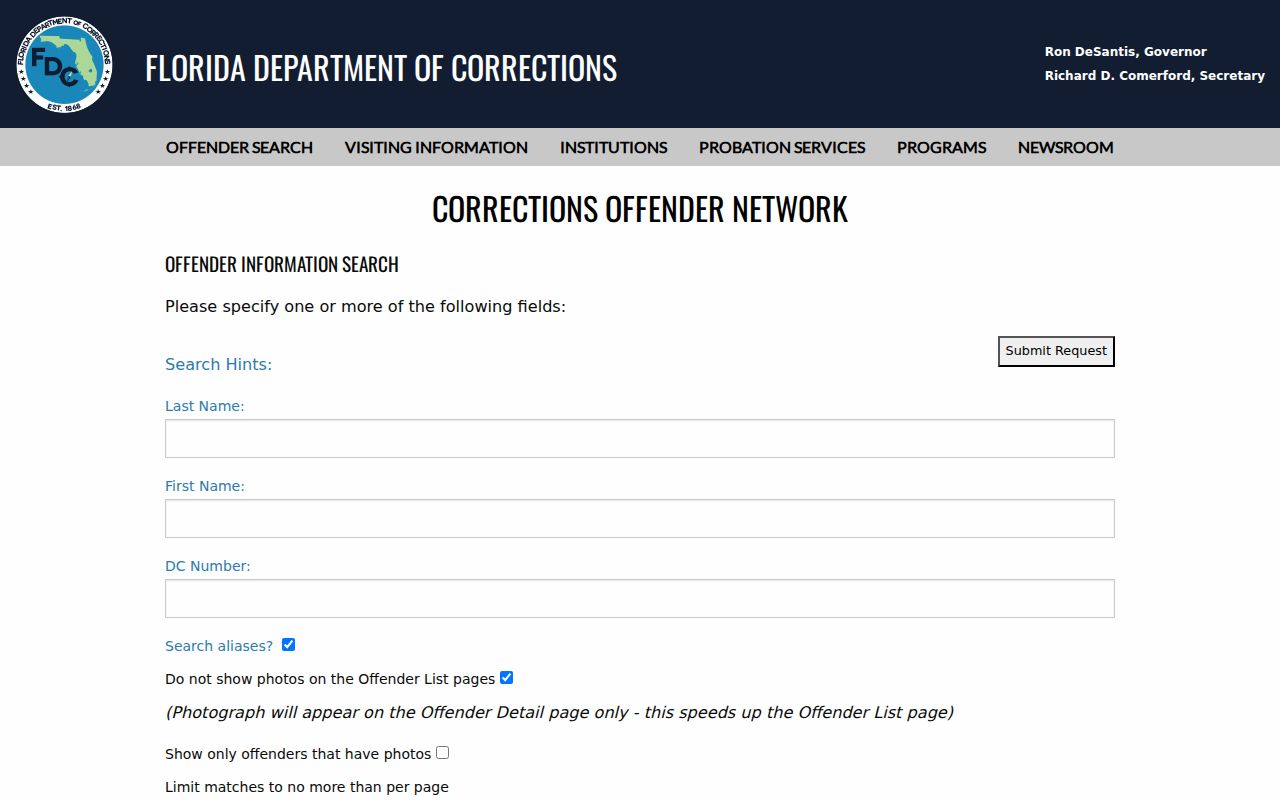
Search results require careful identity matching because names can repeat and custody status changes.
The Palm Beach County Sheriff's custody page is the official route for local booking information.
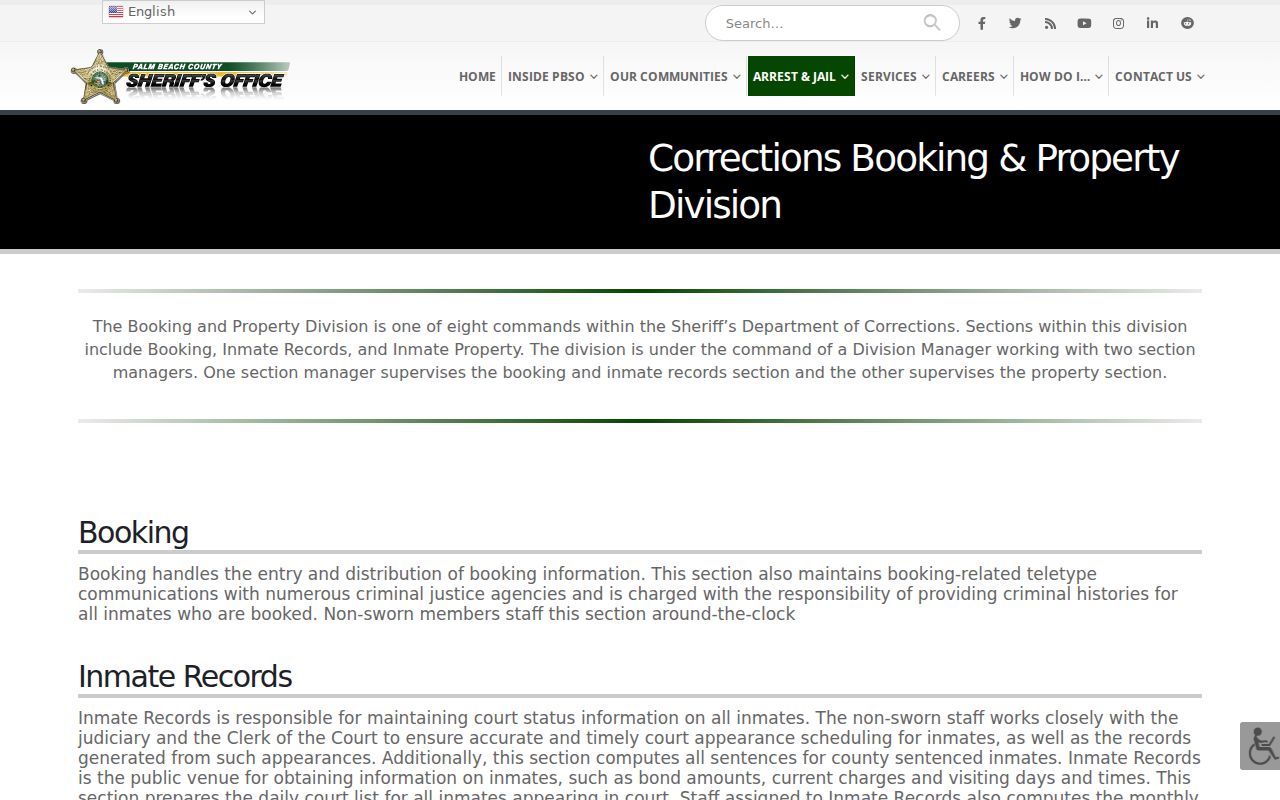
The sheriff's system is a custody source, not proof of a current Palm Springs home address.
The FDLE registry search supports name and neighborhood searches.
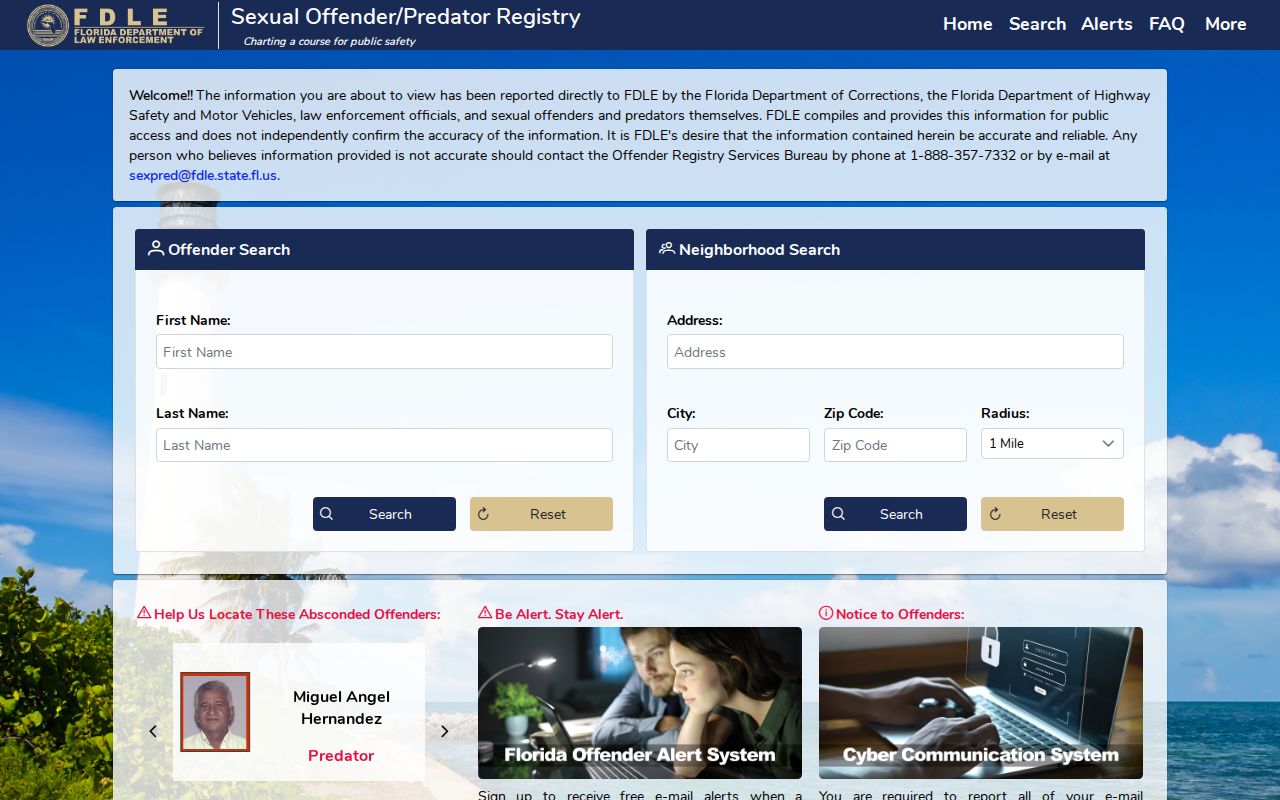
Registry details come with statutory cautions. Florida law also forbids knowingly publishing false registry information or altering it to misrepresent the public record.
Palm Springs Records Geography
A Palm Springs postal address does not settle which office holds an older record. The village began on 700 acres in 1957, reached about 1.6 square miles by 1997, and then expanded largely by annexing land that was already developed and occupied. By 2019, village material described roughly 2,712 acres, or 4.2 square miles. A household can therefore have decades of county permit or code history before the same parcel begins appearing in village files.
Check three labels separately. USPS controls the delivery city and ZIP. PAPA reports the parcel's current municipality and taxing districts. The Village of Palm Springs maps show municipal limits. When those labels disagree, use the postal form for mail and the municipality for routing permit, code, police, and council-record requests. For past records, route the request according to the jurisdiction in effect when the record was created.
The PCN and legal description provide continuity when a postal city or jurisdiction changes. A legal description identifies land by subdivision, lot, block, or survey wording carried through deeds. Those identifiers also help distinguish Palm Springs from Palm Beach, West Palm Beach, and Palm Springs North, which are different places. The Palm Springs ZIP code directory develops this boundary check without adding unverified ZIP codes.
Note: Annexation, not a verified villagewide street renumbering, is the documented address-continuity issue in Palm Springs research.
Historical Palm Springs Directories
Palm Springs has an unusual starting point. The village was chartered in 1957 with 700 acres, a dairy barn, and no human residents. By August 1958, its first section held about 800 homes. There is therefore no authentic pre-1957 Palm Springs household-directory era. Earlier research must use predecessor geography, county land records, nearby Lake Worth directory coverage, plats, and newspapers rather than inventing a village volume.
Exact local Polk or criss-cross runs were not verified in the official sources. Ask the Palm Beach County Library Government Research Service to search its catalog and licensed databases by full name, variants, address, PCN, and approximate years. A criss-cross directory reverses the usual order: it begins with an address or phone number and returns the listed subscriber. Confirm the first and last year of each continuous run and note missing volumes.
The library's new Palm Beach Post Historical Archive covers 1916 to today and became available to cardholders in June 2026. It supports keyword, date, and topic searches plus full-page and article browsing. Exact-address searches, surname plus street, subdivision names, obituaries, social notices, and legal ads can bridge the decades that closed federal census schedules do not cover. Palm Springs did not exist as an incorporated place in the public 1950 census, so use enumeration-district maps and present parcel geography.
Printed directories can suggest occupancy for one year, but a deed proves ownership instead. Pair each directory hit with property, newspaper, voter, probate, or vital evidence. The Palm Springs city directory collections page explains the shelf and request workflow in full.